
This is Part 1 of a two-part series. Part 2 covers backup capacity infrastructure, the CAP requirements that govern temperature-dependent equipment, and the year-end infrastructure checklist. This post covers the physical audit itself — what to prepare, how to safely handle tanks and canisters, how to reconcile your physical findings against your records, and what to do when things don’t match.
A cryostorage inventory audit is not a casual walkthrough. Done correctly, it is a systematic, dual-witnessed, documented process that confirms the identity, location, and compliance status of every specimen in your cryobank. Done carelessly, it creates the very risks it is supposed to prevent: labeling errors, thermal damage to samples, and documentation gaps that become compliance findings or patient safety events.
The procedure below is designed to be adapted into your lab’s SOPs. Every time-sensitive step is flagged. Every dual-witness requirement is noted.
Before You Touch a Tank: What to Gather First
A physical audit cannot begin until you have assembled the documentary baseline you will be reconciling against. Walking into a cryo room with a clipboard and no source data is not an audit — it is a tour.
Documents Required
Assemble the following before audit day:
– Cryosheets (paper and digital) — your current record of what is in each tank, organized by patient
– Tank maps — diagrams showing canister positions within each tank
– Canister and cane logs — records of what is loaded onto each cane within each canister
– EMR exports — patient-level and sample-level data from your electronic medical records system, including active versus inactive status and freeze/thaw history
– Billing ledger — to identify samples associated with active storage fee arrangements versus those with lapsed billing
– Consent forms — storage and disposition consents for each patient with samples in inventory
– Prior audit reports — if a previous audit was performed, its findings establish your baseline and flag any previously identified discrepancies that should have been resolved
Tools Required
– PPE: cryogenic gloves, face shield, and lab coat. Non-negotiable.
– Inventory tablets or audit sheets — pre-numbered paper audit reconciliation sheets are recommended even if you also use a tablet. Pre-numbering means every sheet is accounted for at the end of the audit; you cannot accidentally lose a page or quietly remove one without the gap being immediately obvious. This is a chain-of-custody control, not a bureaucratic formality.
– Barcode or RFID scanners — if your lab uses these for sample identification, have them charged and tested before audit day
– Discrepancy log forms — a dedicated form for recording mismatches, identity questions, and missing samples in real time, separate from the main audit sheets
– Tamper-evident seals — required if retagging is anticipated; see Section 4
Section I: Physical Inventory Reconciliation
The Goal
To verify that every specimen physically present in your cryobank matches a documented patient identity and a recorded storage location — and that every specimen documented in your records is physically present where it is supposed to be.
Tank-Level Procedure
Before opening any canister, complete a tank-level inspection for each storage vessel:
- Assign a unique Tank Audit ID to this vessel for this audit cycle (e.g., AUDIT-2025-TANK-01).
- Record: tank serial number, tank model, current LN₂ level, and monitoring system status.
- Photograph the tank exterior label and log the image with the Tank Audit ID.
- Note any physical damage, unusual condensation, frost patterns, or alarm history since the last audit.
- Pull the tank map and confirm the number of canister positions occupied matches your records before proceeding to canister-level inspection.
Canister-Level Procedure
Work through each canister systematically. Do not open multiple canisters simultaneously.
Safe Canister Lift Procedure
Before beginning any lift, confirm PPE is in place — cryogenic gloves and face shield are required, not optional.
- Identify the canister to be lifted using the tank map. Confirm the canister number on the tank map matches the canister handle label.
- Using long-handled forceps or a specialized lifting hook, locate the canister handle within the tank neck and engage it carefully.
- Unhook the canister from the bottom holder or spider assembly with a steady upward motion. Do not jerk or tilt.
- Raise the canister slowly and vertically through the tank neck. Keep the canister within the neck of the tank for as long as the inspection allows.
- **Do not lift the canister above the frost line** — the visible cold zone in the neck of the tank. Exposing canes to ambient temperature even briefly can compromise sample integrity. The frost line is your safety boundary.
- Complete your canister-level inspection while the canister remains within the neck. Confirm: canister number, total cane count, and that all sample labels are legible, intact, and free of frost damage. Take and save an image of the top of the canister clearly showing all cane labels.
- Limit each lift to under 30 seconds. Return the canister to LN₂ before proceeding.
- Allow a minimum of 3–5 minutes of re-equilibration time between consecutive lifts of the same canister. This allows samples to return to storage temperature before the next inspection pass. Follow your equipment manufacturer’s guidance if it specifies a different interval.
- Cross-check the canister contents against the tank map before returning the canister to its position. Document any discrepancies immediately on the discrepancy log.
- Re-secure the canister in the bottom holder and confirm it is seated correctly before moving to the next canister.
Sample-Level Verification
For samples requiring individual inspection, use a liquid nitrogen holding box — a small insulated vessel kept filled with LN₂ — to safely transfer canes from the canister for inspection without exposing them to ambient air.
Remove no more than 3–5 canes at a time into the holding box. Monitor LN₂ levels in the holding box continuously; refill before the level drops below the canes. Do not allow the holding box to run dry.
For each sample, confirm and record:
– Patient name or ID number
– Unique sample ID (straw or vial label)
– Date of cryopreservation
– Sample type (embryo, oocyte, sperm, or other)
– For embryos: stage and grade if labeled
– Straw or vial count per cane, and contents where labeled
– Physical location: Tank → Canister → Cane → Position
Return each cane to the canister promptly after verification. The total time any cane spends outside of LN₂ should be kept to an absolute minimum. Return all canes to the canister before replacing the canister in the tank. Do not leave canes in the holding box and move on to the next canister.
Retagging Protocol
If during audit you identify labels that are faded, illegible, inconsistent with current labeling standards, or non-standardized, retagging is required. This must be done under dual-witness conditions.
- Both witnesses confirm the sample identity from all available source records before any new label is applied.
- Create a new barcode or ID tag that matches the sample’s existing record exactly.
- Preserve the original ID in the metadata and audit trail — do not discard the original identifier.
- Apply tamper-evident seal if appropriate for your labeling system.
- Record the retag event in the audit trail with both witness signatures, the original label description, the new label ID, and the date.
Performance Metrics: How Do You Know the Audit Was Successful?
Track the following metrics across audit cycles to measure improvement over time:
– % of inventory certified — the primary measure of cryobank integrity
– % of samples with valid consent — a measure of documentation compliance
– % of billing alignment — samples with active, matching storage fee agreements
– Number of unidentified materials — should trend toward zero across successive audits
– Time to reconcile per tank — efficiency metric that improves with process standardization
– Reduction in abandoned inventory — measures effectiveness of ongoing patient outreach programs
Tracking these metrics year over year turns the annual audit from a compliance exercise into a genuine quality improvement tool — one that tells you whether your processes are getting better, and where the remaining gaps are.
Closing Thoughts
A physical cryostorage audit is one of the most consequential things an IVF laboratory does. It is the process by which you confirm that the patients who entrusted you with their most irreplaceable biological material can trust that you actually know where it is, what condition it is in, and what will happen to it. Done with rigor and documented thoroughly, it is also one of your strongest demonstrations of compliance, quality, and institutional integrity.
December is the right time. The procedure is here. The rest is execution.
April Quality Audit: Temperature Dependent Backup Capacity
The Infrastructure That Protects Everything
Every December, while most of the world is winding down, IVF laboratory directors are doing the opposite. The slower clinical pace between holiday closures creates a rare and genuinely useful window — one that experienced lab directors learn to protect fiercely. It is the time to reconcile cryostorage databases against physical tank contents, dispose of embryos that have reached their consent end-dates, restock reagents, archive a year’s worth of records, and make sure the infrastructure holding everything together is ready for the next year.
None of this is glamorous. But if you have ever arrived on a Monday morning to find a liquid nitrogen tank alarm screaming, or worse, discovered it silently failed overnight, you understand exactly why backup capacity planning is not a topic you put off until spring.
Part 1 of this series covers the step-by-step physical audit procedure. This post covers temperature dependent lab equipment infrastructure and the CAP requirements that govern it.
Why December Is the Right Time for This
The IVF lab calendar has a natural rhythm. Cycle volumes typically dip between Christmas and New Year’s, giving laboratories a brief reprieve from the relentless pace of retrievals, fertilization checks, transfers, and biopsies. This window is not a vacation — it is an operational gift.
December is the ideal time to:
– Physically audit every cryostorage tank against your database records
– Identify and process embryos designated for discard, donation, or transfer of custody
– Deep clean incubators, workstations, laminar flow hoods, and cryo storage areas
– Reconcile reagent and supply inventories and place orders for Q1
– Archive paper and electronic records from the closing year
And the best part: you are now fully prepared to test and document backup systems for all temperature-sensitive equipment
Backup Capacity: The Infrastructure That Protects Everything
Temperature-dependent equipment in an IVF laboratory includes liquid nitrogen dewars and vapor-phase tanks for long-term cryostorage, incubators for embryo and gamete culture, refrigerators and freezers for reagent and media storage, and warming blocks and heated stages used during procedures. Each of these represents a potential single point of failure. The question is not whether one will fail — it is whether your lab is prepared when it does.
Liquid Nitrogen Storage: The Highest Stakes
Cryopreserved embryos, oocytes, and sperm represent years of patient effort, significant financial investment, and in many cases a person’s only remaining path to biological parenthood. The vessels holding them are, at their core, insulated containers relying on liquid nitrogen to maintain temperatures around -196°C. Modern vapor-phase tanks are excellent. While all tanks are robust, they are not infallible.
Backup capacity for cryostorage means having sufficient additional tank volume available — either empty tanks kept on site or a documented arrangement with a nearby facility — to absorb the entire contents of your largest tank if an emergency transfer becomes necessary. It means having liquid nitrogen supply agreements that guarantee delivery even during weather disruptions or supplier shortages. It means alarm systems with redundant notification pathways: audible local alarms, remote monitoring, and after-hours phone escalation to someone who will actually answer.
Incubators: More Redundancy Than You Think You Need
Most IVF labs run multiple incubators, and experienced embryologists intuitively spread embryos across units to reduce risk concentration. But true backup capacity means having a plan for what happens if two incubators fail simultaneously — not just one. It means documenting the answer to: if we lost half our incubator capacity tonight, where would everything go, and who would make that call?
Backup incubators do not need to be identical to your primary units. A benchtop incubator maintained in working condition, properly calibrated, and stocked with appropriate gas concentrations can bridge a critical gap while a primary unit is repaired or replaced. The key is that it exists, it is ready, and your team knows how to use it under pressure.
Reagent Cold Chain: The Quietly Vulnerable Link
Reagents and culture media stored at 2–8°C or -20°C represent a supply chain vulnerability that does not always get the same attention as cryostorage. A refrigerator compressor failure on a Friday afternoon can render thousands of dollars of culture media unusable by Monday morning — and more importantly, delay or compromise cycle outcomes for patients already in stimulation.
Backup refrigeration capacity, even a single secondary unit designated for media overflow and emergency transfer, is a worthwhile investment. At minimum, your standard operating procedures should specify what happens to reagents if primary cold storage fails, including acceptable temperature excursion windows for each product category and the contact information for your media supplier’s emergency line.
What CAP Requires: A Practical Reference Table
The College of American Pathologists (CAP) reproductive laboratory accreditation checklist addresses backup capacity, storage, inventory, and disposition across several checklist items. The table below organizes the most relevant requirements with a plain-language explanation of what each one actually demands in practice — not just what it says.
CAP Checklist Item | Requirement Summary | What It Means in Practice |
**RLM.08575** Temperature-Dependent Equipment Failure Plan | Written plan for backup equipment covering: identification, capacity, location, transfer process, contact personnel, and patient notification. Annual evaluation required. Inter-lab agreement required if backup is offsite. | Your backup plan must be written, specific, and tested annually. A verbal understanding with another lab does not satisfy this requirement. Update contact lists every year.
**GEN.61900** Inventory Control | Effective supply inventory control system in operation. | Know what you have, where it is, and when it expires — for reagents, consumables, and specimens. An Inventory Audit reconciliation directly satisfies this.
**RLM.12000** Cryostorage Inventory | Records available for current inventory of all specimens in cryobanks. | The database is not the inventory — the tank is. They must match. Discrepancies require investigation and documentation.
**RLM.12400** Long-Term Disposition | Written procedure for storage duration, informed consent, and long-term disposition of cryopreserved gametes and embryos. | All December discards and custody transfers must be performed under a current, signed consent with complete disposition records.
**RLM.03975** Specimen Handling and Disposition | Records allow tracking of disposition for all gametes and embryos handled or stored. | Every embryo discarded, donated, or transferred needs a complete chain-of-custody record. This is patient protection, not paperwork.
**RLM.08000** Specimen Handling | System to verify and maintain specimen identity throughout receipt, storage, processing, and disposition. | Identity verification must be active and documented at every step — not assumed.
**GEN.40506** Secured Specimen Storage | Original specimens maintained appropriately when not in possession of an authorized individual. | Storage conditions must be defined and met continuously. Backup capacity planning is the operational expression of this requirement.
**GEN.40507** Specimen Retention and Storage | Retention and storage conditions defined for each specimen type using chain-of-custody procedure. | Storage conditions are not optional or approximate. They are defined, documented, and your backup plan must maintain them.
**GEN.40509** Secured Records | Chain-of-custody and testing records retained for minimum two years in a limited-access secured area. | Year-end archiving moves completed cycle records to secure long-term storage. This is also when you confirm your retention schedule complies with applicable state law.
A Closer Look at RLM.08575
This checklist item deserves special attention because it is the most operationally specific — and the most likely to generate a finding if your plan exists only in someone’s head.
The CAP note attached to RLM.08575 specifies that procedures for backup equipment must address: equipment identification, capacity, physical location, the transfer process to maintain required temperature range, contact personnel, and patient notification. It explicitly covers emergent situations including disasters, and it requires timely notification of patients regarding the location and status of their cryopreserved cells and tissues if a transfer becomes necessary.
Two elements of this requirement routinely catch labs off guard. First, the annual evaluation is not optional — it requires physically verifying that backup equipment is functional and has adequate capacity, and confirming that the contact personnel list is current. People change roles, leave organizations, and update phone numbers. A contact list that was accurate eighteen months ago may not reach anyone at 2 a.m. during a power failure.
Second, if your backup equipment is located at another laboratory or if you have a storage agreement with another facility, a written inter-laboratory agreement is required. A handshake understanding with the lab down the street does not satisfy this requirement. The agreement must exist, be current, and be immediately accessible to the people who would need to act on it.
The Infrastructure Checklist
Use this as a working tool for your year-end review. Part 1 of this series provides the detailed physical inventory audit procedure.
Backup Equipment Plan (RLM.08575 Annual Evaluation)
[ ] Pull your written backup equipment plan and verify it names specific equipment with model, serial number, location, and confirmed capacity
[ ] Physically test each backup unit — power on, confirm temperature stability, verify gas supply if applicable
[ ] Confirm backup capacity is sufficient to receive the full contents of each corresponding primary unit
[ ] Update contact personnel list and verify every number reaches the right person after hours
[ ] Confirm inter-laboratory storage agreements are current, signed, and filed accessibly
[ ] Test alarm systems including remote monitoring and after-hours notification chains
[ ] Document the completed evaluation with date and signatures
Cryostorage Audit (RLM.12000)
[ ] Schedule physical tank audit — see Part 2 for full procedure
[ ] Confirm LN₂ levels and fill schedule through the holiday closure period
[ ] Document any discrepancies and initiate investigation per your deviation procedure
[ ] Confirm backup tank capacity and emergency transfer protocol is current
Reagent and Supply Inventory (GEN.61900)
[ ] Count all reagents, media, and consumables against inventory records
[ ] Flag and quarantine items past expiration or outside storage specifications
[ ] Identify critical items with lead times longer than your buffer stock can cover
[ ] Place Q1 orders before holiday supply chain delays take effect
[ ] Verify all cold storage equipment is functioning and recently calibrated
Disposition Workflows (RLM.12400, RLM.03975)
[ ] Pull list of embryos and gametes with approaching or past consent end-dates
[ ] Confirm informed consent documentation is complete before initiating any discard
[ ] Complete disposition records and obtain required witness signatures
[ ] Notify patients as required by consent documentation and applicable state law
Records and Archiving (GEN.40509)
[ ] Archive completed cycle records per your retention schedule
[ ] Confirm electronic records are backed up and access controls are current
[ ] Update any SOPs that changed during the year and retire obsolete versions
[ ] Document completion of annual inventory per GEN.61900 and RLM.12000
The Bigger Picture
An IVF laboratory is, at its core, a controlled environment sustained by infrastructure. Incubators, cryotanks, refrigerators, alarms, gas supplies, and backup systems are the unseen architecture that makes everything else possible. Embryologist skill, clinical protocol, and patient care all depend on that infrastructure functioning reliably — not just on a Tuesday afternoon, but at 3 a.m. on a holiday weekend when something unexpectedly fails.
That is not administrative housekeeping. That is risk management, quality assurance, and patient safety rolled into a to-do list.
The patients whose embryos are in your tanks are counting on you to make every effort to safeguard their precious cells.
Continue to Part 1: How to Perform a Physical Cryostorage Inventory Audit — a step-by-step procedure covering tank-level inspection, canister and cane verification, sample-level reconciliation, documentation requirements, and post-audit action pathways.
The cost of building a family in the United States was already difficult to defend. What is happening right now makes it worse, and the people absorbing the consequences are patients.
In the past eighteen months, IVF laboratories have seen a 5 to 6 percent tariff surcharge added by suppliers, followed by an 8 percent fuel surcharge layered on top. Those numbers are not abstract. They are passed through the system — into reagent costs, consumable budgets, cryostorage operations, and ultimately into what programs charge patients who are already spending money they often do not have on treatment that is still not covered by most insurance plans in this country.
The tariffs driving these increases are not accidents of the market. They are policy choices. And while the intended targets are geopolitical, the collateral damage lands squarely on clinical laboratories trying to run ethical, compliant, high-quality programs on margins that were never generous to begin with.
That is before we talk about what is happening globally. Supply chains that were already stressed from COVID-era disruptions are now contending with active geopolitical instability affecting shipping routes, port operations, and the sourcing of raw materials that go into the culture media, cryoprotectants, and sterile consumables that IVF laboratories cannot function without. Add severe weather events compounding freight delays and cold-chain risk, and you have a system operating with very little slack.\
Lab directors are not passive observers in this. We are the ones who have to build the emergency plans, validate the alternate products, document the substitutions in a way that satisfies CAP and CLIA requirements, and explain to clinical teams and patients why timelines are shifting or costs are changing. The regulatory infrastructure does not pause for supply disruptions. Neither does patient care.
Now there are media formulation changes driven by geopolitical pressures. How to protect your laboratory budget when suppliers add surcharges without meaningful notice. Emergency SOPs and continuity planning for ongoing supply chain instability. And for offsite laboratory directors, the real and rising costs of travel in an environment that is neither predictable nor cheap.
If you direct a laboratory, supervise a team, or carry responsibility for operational continuity in an ART program, this conversation is for you.
Current Cost Pressure Context Supplier surcharges have compounded over consecutive cycles: 5–6% tariff surcharge (2025) + 8% fuel charge (2026 add-on). Labs operating on fixed-cycle pricing or legacy contracts are most exposed. This session addresses both immediate mitigation and long-horizon planning.
Media Formulation Changes: What Suppliers Are Doing and Why
→ Overview of reported formulation adjustments by major culture media manufacturers in response to U.S. import tariffs on raw chemical constituents and packaging materials
→ Geopolitical drivers: tariff exposure on goods from key trading partners affecting BSA sourcing, amino acid precursors, and sterile consumables
→ Alternate product evaluation: process for qualifying a new media lot or product under CLIA/CAP standards without compromising clinical outcomes
▸ Internal validation requirements: KPIs, historical controls, minimum cycle threshold
▸ FDA 21 CFR Part 1271 implications for labs using donor tissue: documentation obligations when switching reagents in donor gamete processing workflows
▸Vendor change notification requirements: what suppliers are obligated to disclose vs. what labs must proactively investigate
→Discussion: Have members received formal notification of formulation or lot changes from suppliers? What QA documentation was provided?
Protecting the Laboratory Budget: Cost Escalation Strategies
5–6%: Tariff surcharge added 2025
+8%: Fuel/freight surcharge 2026
~14%” Compounded cost increase on goods
What is your lab’s exposure?
→ Auditing current vendor contracts: understanding surcharge clauses, escalation caps, and notice requirements for price changes
→ Renegotiation leverage: volume commitments, multi-year agreements, and group purchasing organization (GPO) participation as cost controls
→ Alternate sourcing: domestic vs. international suppliers; evaluating CE-marked products for U.S. lab use and regulatory acceptability under current CAP/CLIA frameworks
→ Strategic inventory practices: safety stock thresholds, shelf-life management, and capital exposure of pre-buying vs. just-in-time models
→ Communicating cost pressures upward: making the case to administration for budget adjustments with data-driven cost modeling
→ Discussion: How are members absorbing these costs? Are clinical fee structures being revisited at your institution?
Offsite Lab Directors: Travel Safety & Per Diem Frameworks
→ Current travel safety landscape for lab directors traveling to supervised sites: domestic considerations (airline reliability, airport disruption) and international medical travel advisory changes
→ Practical travel tips and protocols: documentation to carry (HCLD credential copies, site contracts, emergency contacts), health and safety precautions, and communication check-in expectations with home institution
→ Per diem rate structures for offsite lab direction: what is reasonable, what is defensible, and how to structure agreements to keep pace with rising travel costs
▸GSA rate benchmarks as a reasonable anchor point
▸Fuel surcharge pass-through: should directors be absorbing or billing these?
▸Contract language: building in annual cost-of-travel adjustments
→ Insurance considerations: professional liability coverage during offsite visits, travel medical insurance, and what gaps may exist in standard malpractice policies for remote or consulting directors
→ Discussion: Are members revisiting their offsite agreements in light of cost increases? What are standard practices in the group?
Emergency Plans & SOPs for Supply Chain Disruption
→ Elements of a robust supply chain continuity SOP: triggers for activation, decision tree for alternate sourcing, patient communication protocols during consumable shortages
→ Critical supply triage: identifying your non-negotiable consumables (culture media, oil, dishes, cryoprotectants, sperm prep reagents) vs. items with acceptable alternatives
→ Regulatory documentation: how to document supply chain substitutions in a way that satisfies CAP inspection requirements and CLIA compliance
▸QC records for alternative lot/product use
▸Cycle reporting: when do reagent changes need to be flagged?
→ Donor tissue workflows under shortage: FDA-regulated HCT/P documentation obligations do not pause during supply disruptions; what contingency plans must address
→ International supply chain exposure: labs sourcing from Europe or Asia and exposure to shipping delays, customs holds, and currency-driven price volatility
→ SOP review exercise: members share one gap identified in their current emergency supply plan; group problem-solves in real time
When people talk about IVF clinics, they usually focus on physicians, SART success rates, or the medical director listed on the website. What is discussed far less often is the role that actually determines how an IVF laboratory functions day to day.
That role is the Technical Supervisor.
In IVF laboratories that operate with an off site laboratory director, the technical supervisor is the most important laboratory position. This is not opinion, it is reflected directly in federal regulation.
Under CLIA, any change in a laboratory’s technical supervisor must be reported within 30 days. The government does not require this level of reporting for a role unless it is critical to laboratory operations.
So the obvious question becomes one we have not been asking loudly enough:
Who are the technical supervisors running IVF labs across the United States?
What Does an IVF Lab Technical Supervisor Actually Do?
The technical supervisor is responsible for the daily operation of the IVF laboratory. This includes:
- Oversight of embryo handling and laboratory procedures
- Staff training and competency assessment
- Quality control and quality assurance programs
- Documentation, audits, and regulatory compliance
- Immediate decision making when problems occur
In clinics with an off site laboratory director, the technical supervisor is the highest authority physically present in the lab. When an issue arises, this is the person who identifies it, documents it, and corrects it in real time.
For patients, this means the technical supervisor directly influences laboratory quality, consistency, and safety, even though their name is rarely visible.
Degrees, Credentials, and Certification Matter
Not all technical supervisors have the same training or credentials, and that distinction is important.
Across IVF clinics in the United States, technical supervisors may hold:
- A Bachelor of Science degree
- A Master of Science degree
- A PhD
Some technical supervisors also hold a formal Technical Supervisor certification from the American Board of Bioanalysis, commonly listed as TS ABB. Others meet only the minimum CLIA qualification requirements without holding specialty certification.
These are not equivalent credentials.
CLIA qualification defines minimum eligibility to hold the role.
ABB certification demonstrates specialized training and validated expertise in laboratory supervision.
Why Transparency in IVF Lab Leadership Is Essential
IVF Clinics routinely give detailed information about their physician, their clinic’s outcomes, and their treatment plan. What they rarely tell is who is responsible for the laboratory where their embryos are created, cultured, and stored.
- Who supervises the IVF laboratory day to day
- What education and training that person has
- Whether they hold formal technical supervisor certification
- Who is accountable when the laboratory director is off site
If a role is important enough that CLIA requires reporting changes within 30 days, it is important enough for patients to understand who holds it.
Celebrate the Technical Supervisor
Many technical supervisors carry immense responsibility with limited recognition, authority, or support.
In “Low E-visibility of embryologists on fertility clinic websites,” a real problem is highlighted. Embryologists, even senior ones, are largely invisible to patients despite their central role in treatment outcomes.
The paper frames increased visibility as potentially beneficial because it:
- Enhances professional recognition
- Improves transparency
- Helps patients understand who is involved in their care
- Aligns IVF with norms seen in other medical specialties
They are often the backbone of laboratory operations, ensuring quality and compliance under constant pressure.
When laboratory directors are off site, the technical supervisor is not a supporting role.
They are the laboratory.
The Real Risk: Harassment and Targeting
Embryologists can be subjected to harassment from:
Radical anti-IVF or anti-abortion groups
Emotionally distressed patients
Media seeking controversy
Aggressive recruiters
Vendors exploiting professional exposure
These risks are real and documented, and dismissing them would be unethical.
The College of American Pathologists (CAP) has released its updated checklists for 2024, bringing several significant changes across various accreditation programs. Staying informed about these revisions is crucial for laboratories to maintain compliance and ensure a smooth accreditation process. This blog post summarizes the key substantive changes found in the Common, Director Assessment, Reproductive Laboratory, and Laboratory General checklists.
Common Checklist (COM) Updates
The Common Checklist, which applies to all laboratories, sees several key clarifications and new additions. One notable change is to COM.01200, where the activity menu must now be accurate for all related information, not just test activities. Additionally, laboratories subject to CLIA regulations must now explicitly list patient-specific results on the CAP Activity Menu, a change from the previous wording of “reported to.”
New qualifications for technical supervisors have been added for the specialties of Cytogenetics and Transfusion Medicine (COM.01400), and a new requirement (GEN.41096) has merged with the existing COM.22950 from 2023.
Director Assessment (DRA) Checklist: Focus on Qualifications and Remote Oversight
The Director Assessment Checklist introduces new requirements for high-complexity testing directors. A key change in DRA.10100 mandates that a doctoral degree holder must have at least 20 continuing education (CE) credit hours covering director responsibilities*. However, the This is a shift from the previous one-year laboratory training requirement. The same requirement has also been updated for moderate-complexity laboratory directors, who must now have board certification and at least one year of experience in directing or supervising nonwaived testing.
The checklist also introduces new rules for remote oversight. DRA.10432 and DRA.10433 are new requirements specifying on-site visit frequencies for laboratories, both inside and outside the US, respectively. A new requirement under DRA.10435 directs laboratories to have a specific policy for the frequency of on-site visits if the director’s activities are conducted remotely.
Reproductive Laboratory (RLM) Checklist: Enhanced Cryopreservation and Personnel Rules
The Reproductive Laboratory Checklist now includes a greater emphasis on back-up plans for temperature-dependent equipment. RLM.03955 has been revised to require process plans for utilizing back-up equipment, including protocols for emergent situations and an annual assessment of the equipment’s functionality. This is a significant update from the prior focus on simply having a plan.
Regarding personnel, a key change in RLM.10250 has removed “physical” from the list of acceptable bachelor’s degrees for embryology laboratory personnel, refining the qualifications for these roles. A new clause (RLM.10166) was added for Department of Defense laboratories, clarifying the process for evaluating the equivalency of qualifications for directors trained outside the US.
Laboratory General (GEN) Checklist: Extensive Revisions to Quality Control and Safety
The Laboratory General Checklist has undergone the most extensive changes, particularly concerning proficiency testing (PT), equipment maintenance, and safety.
Equipment and Maintenance:
- GEN.20180 now explicitly requires instrument maintenance and cleaning to be performed according to manufacturer instructions.
- A new requirement, GEN.20450, mandates a policy for preventive maintenance on instruments not in use for extended periods.
- Conversely, the requirement for inspecting refrigerators and freezers every six months for cleanliness (GEN.20665) has been removed.
Proficiency Testing (PT):
- Several new requirements have been added to reinforce best practices for PT.
- GEN.50505 requires PT results to be reported in accordance with the PT program’s instructions.
- GEN.50555 now mandates that laboratory policies for handling PT samples define acceptable testing conditions.
- The requirement for corrective action plans has been strengthened with GEN.50875, which states that the plan must now address all PT results that are not perfect, and GEN.50850, which specifies that the plan must be documented and approved by the director.
- The requirements for on-site reviews of PT results (GEN.51500 and GEN.51600) have been revised to include the process for evaluating and documenting the results.
Safety:
- The entire requirement for emergency eyewash and shower equipment (GEN.70010) has been replaced by two new ones (GEN.70020 and GEN.70030), which now explicitly require the equipment to be accessible, inspected, and maintained per ANSI standards, with specific instructions for weekly activations and visual examinations.
- The requirement for a chemical hygiene plan (GEN.60500) has been deleted.
By understanding these changes, laboratory professionals can proactively update their policies and procedures to align with the latest CAP standards, ensuring continued compliance and quality.
High Complexity Laboratory Director, 20 Continuing Education Requirements
* At the end of June 2025, the Centers for Medicare & Medicaid Services (CMS), which oversees the Clinical Laboratory Improvement Amendments (CLIA) program, announced it was suspending enforcement of its decision to require, as a condition for eligibility to serve as a High Complexity Laboratory Director, 20 continuing education (CE) credits in laboratory practice that cover CLIA laboratory director responsibilities.
To be consistent with this new CLIA requirement, earlier this year the American Board of Bioanalysis (ABB) mandated the same 20 CE credits for candidates seeking to sit for High Complexity Laboratory Director examinations (including HCLD, BCLD, PHLD, ELD and ALD). In light of CMS/CLIA’s decision to suspend enforcement of the 20 CE credit requirement, ABB decided to suspend this requirement from ABB’s eligibility criteria for high complexity laboratory director certification until such time that CMS decides to enforce this requirement. ABB also believes that its General Knowledge examination for laboratory directors covers this subject matter.
As a result, individuals who previously applied for HCLD, BCLD, PHLD, ELD, and ALD certification after December 28, 2024, do not have to meet this requirement.
Also consistent with CLIA regulations, ABB announced an alternative pathway for candidates whose doctoral degrees may not be in a chemical, biological, clinical or medical laboratory science, or medical technology. Under this pathway, applicants may qualify to take the HCLD, BCLD, PHLD, ELD, and ALD examinations by completing 16 credit hours of doctoral level coursework in a chemical, biological, clinical or medical laboratory science, or medical technology. This adjustment is intended to broaden access while ensuring candidates have the necessary academic preparation for high-complexity laboratory oversight.
Finally, the revised CLIA regulations did not have a provision to “grandfather” Clinical Consultants. Therefore, to qualify as a Clinical Consultant, all previously qualified laboratory directors would have to “requalify” as laboratory directors under the December 28, 2024, rules that require directors to have 20 CE credits in laboratory practice that cover laboratory director responsibilities. Since CLIA enforcement of that requirement has been suspended, individuals who qualified as Clinical Consultants before December 28, 2024, do not have to earn the 20 CE credits to continue to qualify as Clinical Consultants.
Tips for Performing Your CAP Self-Inspection
Performing a comprehensive self-inspection will help you achieve:
- Ongoing compliance with the CAP checklist requirements
- A continual state of readiness for your next on-site CAP inspection
- Improved laboratory performance and better patient care
- Prepare
- Formalize a self-inspection procedure.
- View the Laboratory Data Report on e-LAB Solutions™ for accuracy.
- Notify the CAP of any demographic and/or test activity changes.
- Confirm that proficiency testing (PT) is being performed for each required analyte.
- Review the Laboratory Activity Menu with PT Options (or the Missing PT Enrollment) Reports for required PT program enrollment vs. alternate performance assessment.
- Notify CAP of any Activity Menu changes that may affect PT enrollment.
- Determine the date that the inspection will occur (this should be unannounced).
- Select a team to perform the unannounced inspection.
- Involve a variety of staff levels.
- Include a mix of supervisory staff, non-supervisory staff, residents, and fellows.
- Consider using a sister facility and cross-discipline lines for a fresh, unbiased perspective.
- Encourage staff and inspectors to complete inspector education. To access the courses:
- Go to cap.org and log in to e-LAB Solutions Suite with your individual user ID and password.
- Select CAP Accreditation, CAP Accreditation Resources, Inspector Resources, Online Inspector Training.
- Register for the Team Leader or Team Member training session.
- Conduct
- Review previously cited deficiencies and proficiency testing performance.
- Check deficiency responses against current practice.
- Ensure compliance with each applicable checklist question, including any new CAP requirements.
- Communicate with a variety of staff levels.
- Include all personnel involved in the testing process, such as: phlebotomists, accessioning/processing techs, bench techs, and supervisors/managers.
- As you perform the self-inspection, consider how you would respond to the following if the supervisor or laboratory director was not present:
- Are you prepared to explain a certain procedure or practice?
- Do you know where various policies are located?
- Do you know where quality control and instrument maintenance records are located?
- Improve
- Conduct a summation conference.
- Review cited deficiencies.
- Develop and document a corrective action plan with appropriate staff members.
- Demonstrate implementation of the plan with a review of follow-up corrective action taken to ensure compliance.
- Self-inspection documentation must be readily accessible for the next on-site inspection.
Need assistance? Call 800-323-4040 or 847-832-7000 or email accred@cap.org.
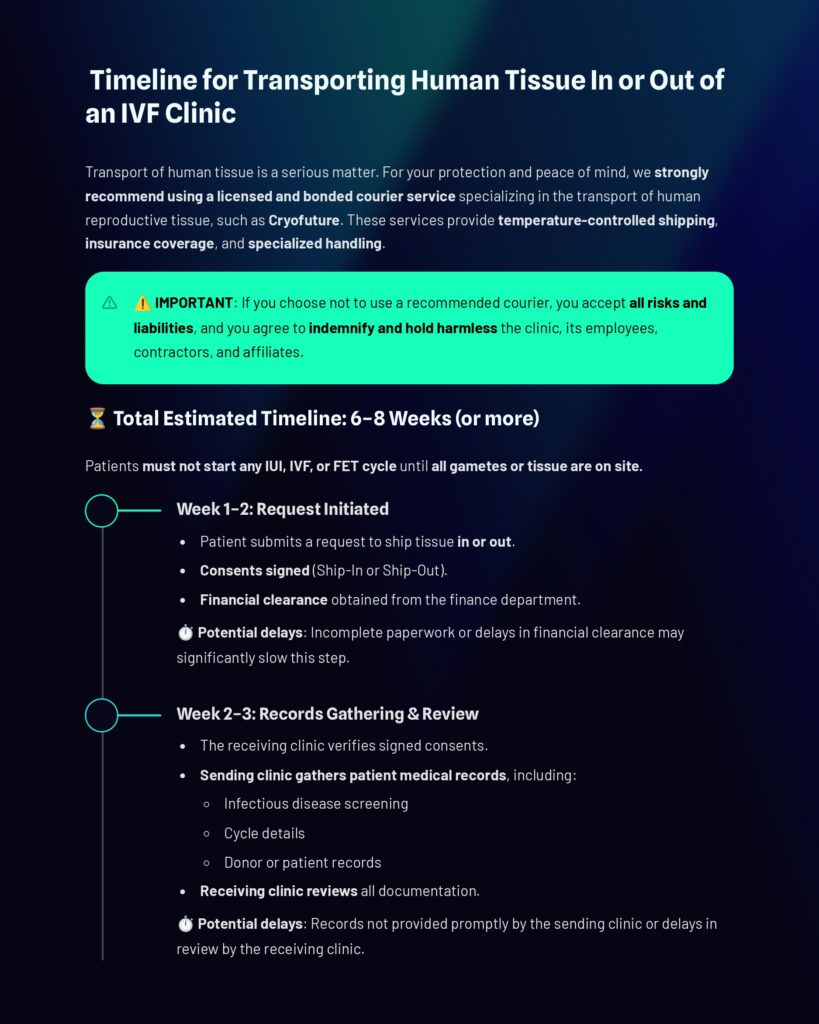
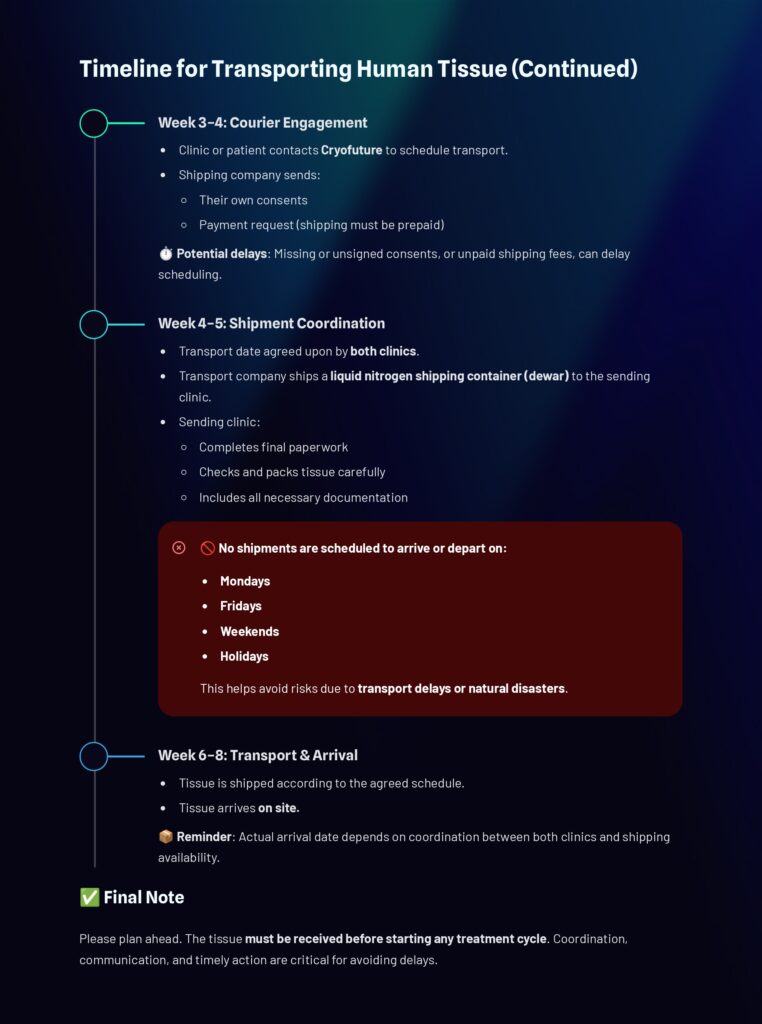
IVF Clinics take the safe transport of reproductive tissue seriously—for our patients’ protection and peace of mind.
Whether you’re coordinating a ship-in or ship-out, transporting embryos, eggs, or sperm requires 6–8 weeks and careful planning across multiple steps.
We’ve created a clear, patient-friendly infographic to guide your team and your patients through the entire process—from signing consents to confirming tissue arrival.
 Featuring recommended couriers (Cryofuture)
Step-by-step timeline
Critical reminders to avoid delays
Final note: Tissue must be on-site before any IUI, IVF, or FET cycle begins
 Download and share with your staff and patients to ensure a seamless experience.
Spring is a season of new life, renewal, and growth. It’s a time when the earth awakens from its winter sleep and bursts forth with vibrant colors and new beginnings. For those struggling with infertility, spring can symbolize hope and the possibility of new life.
If you’re waiting to get pregnant, the journey can be long and difficult. It’s easy to become overwhelmed with the daily routine of charting cycles, taking medications, and undergoing fertility treatments. But as the days get longer and warmer, it’s important to take a step back and appreciate the beauty of the season and the hope it brings.
Just as the earth goes through cycles of growth and renewal, so do our bodies. Infertility can be a frustrating and emotional rollercoaster, but it’s important to remember that every cycle is a new beginning. With each new cycle, there’s the possibility of new life, and the hope that this time will be the one.
Oocytes, or eggs, undergo a complex process of maturation before they can be fertilized. This process takes several months, and is influenced by a variety of factors, including age, genetics, and lifestyle choices. There are steps that individuals can take to support the maturation process and increase their chances of conception. One of the most effective ways is to make lifestyle changes and incorporate certain supplements into the daily routine.
For example, studies have shown that maintaining a healthy weight, exercising regularly, and reducing stress levels can all positively impact oocyte maturation and improve fertility. In addition, taking supplements such as folic acid, vitamin D, and omega-3 fatty acids can also support the maturation process and improve overall reproductive health.
Spring is also a time for self-care and renewal. Take some time to pamper yourself, whether it’s with a relaxing bubble bath, a massage, or a day out in nature. Focus on activities that bring you joy and relaxation, and don’t forget to connect with loved ones for support.
The season of renewal also provides an opportunity to reflect on your fertility journey and set new goals. Take some time to reassess your priorities, and consider any lifestyle changes that might improve your chances of conceiving. This could mean adjusting your diet, exercise routine, getting enough high quality sleep, or reducing stress levels.
Remember, you’re not alone on this journey. Seek out support from friends, family, or a professional counselor if you’re feeling overwhelmed. Spring is a season of new beginnings, and with each new cycle, there’s the possibility of new life and hope.
So, as you embrace the season of spring, remember that your journey towards parenthood is also a journey of growth and renewal. Take a deep breath, appreciate the beauty around you, and have faith that your new beginning is just around the corner