
When people talk about IVF clinics, they usually focus on physicians, SART success rates, or the medical director listed on the website. What is discussed far less often is the role that actually determines how an IVF laboratory functions day to day.
That role is the Technical Supervisor.
In IVF laboratories that operate with an off site laboratory director, the technical supervisor is the most important laboratory position. This is not opinion, it is reflected directly in federal regulation.
Under CLIA, any change in a laboratory’s technical supervisor must be reported within 30 days. The government does not require this level of reporting for a role unless it is critical to laboratory operations.
So the obvious question becomes one we have not been asking loudly enough:
Who are the technical supervisors running IVF labs across the United States?
What Does an IVF Lab Technical Supervisor Actually Do?
The technical supervisor is responsible for the daily operation of the IVF laboratory. This includes:
- Oversight of embryo handling and laboratory procedures
- Staff training and competency assessment
- Quality control and quality assurance programs
- Documentation, audits, and regulatory compliance
- Immediate decision making when problems occur
In clinics with an off site laboratory director, the technical supervisor is the highest authority physically present in the lab. When an issue arises, this is the person who identifies it, documents it, and corrects it in real time.
For patients, this means the technical supervisor directly influences laboratory quality, consistency, and safety, even though their name is rarely visible.
Degrees, Credentials, and Certification Matter
Not all technical supervisors have the same training or credentials, and that distinction is important.
Across IVF clinics in the United States, technical supervisors may hold:
- A Bachelor of Science degree
- A Master of Science degree
- A PhD
Some technical supervisors also hold a formal Technical Supervisor certification from the American Board of Bioanalysis, commonly listed as TS ABB. Others meet only the minimum CLIA qualification requirements without holding specialty certification.
These are not equivalent credentials.
CLIA qualification defines minimum eligibility to hold the role.
ABB certification demonstrates specialized training and validated expertise in laboratory supervision.
Why Transparency in IVF Lab Leadership Is Essential
IVF Clinics routinely give detailed information about their physician, their clinic’s outcomes, and their treatment plan. What they rarely tell is who is responsible for the laboratory where their embryos are created, cultured, and stored.
- Who supervises the IVF laboratory day to day
- What education and training that person has
- Whether they hold formal technical supervisor certification
- Who is accountable when the laboratory director is off site
If a role is important enough that CLIA requires reporting changes within 30 days, it is important enough for patients to understand who holds it.
Celebrate the Technical Supervisor
Many technical supervisors carry immense responsibility with limited recognition, authority, or support.
In “Low E-visibility of embryologists on fertility clinic websites,” a real problem is highlighted. Embryologists, even senior ones, are largely invisible to patients despite their central role in treatment outcomes.
The paper frames increased visibility as potentially beneficial because it:
- Enhances professional recognition
- Improves transparency
- Helps patients understand who is involved in their care
- Aligns IVF with norms seen in other medical specialties
They are often the backbone of laboratory operations, ensuring quality and compliance under constant pressure.
When laboratory directors are off site, the technical supervisor is not a supporting role.
They are the laboratory.
The Real Risk: Harassment and Targeting
Embryologists can be subjected to harassment from:
Radical anti-IVF or anti-abortion groups
Emotionally distressed patients
Media seeking controversy
Aggressive recruiters
Vendors exploiting professional exposure
These risks are real and documented, and dismissing them would be unethical.
The College of American Pathologists (CAP) has released its updated checklists for 2024, bringing several significant changes across various accreditation programs. Staying informed about these revisions is crucial for laboratories to maintain compliance and ensure a smooth accreditation process. This blog post summarizes the key substantive changes found in the Common, Director Assessment, Reproductive Laboratory, and Laboratory General checklists.
Common Checklist (COM) Updates
The Common Checklist, which applies to all laboratories, sees several key clarifications and new additions. One notable change is to COM.01200, where the activity menu must now be accurate for all related information, not just test activities. Additionally, laboratories subject to CLIA regulations must now explicitly list patient-specific results on the CAP Activity Menu, a change from the previous wording of “reported to.”
New qualifications for technical supervisors have been added for the specialties of Cytogenetics and Transfusion Medicine (COM.01400), and a new requirement (GEN.41096) has merged with the existing COM.22950 from 2023.
Director Assessment (DRA) Checklist: Focus on Qualifications and Remote Oversight
The Director Assessment Checklist introduces new requirements for high-complexity testing directors. A key change in DRA.10100 mandates that a doctoral degree holder must have at least 20 continuing education (CE) credit hours covering director responsibilities*. However, the This is a shift from the previous one-year laboratory training requirement. The same requirement has also been updated for moderate-complexity laboratory directors, who must now have board certification and at least one year of experience in directing or supervising nonwaived testing.
The checklist also introduces new rules for remote oversight. DRA.10432 and DRA.10433 are new requirements specifying on-site visit frequencies for laboratories, both inside and outside the US, respectively. A new requirement under DRA.10435 directs laboratories to have a specific policy for the frequency of on-site visits if the director’s activities are conducted remotely.
Reproductive Laboratory (RLM) Checklist: Enhanced Cryopreservation and Personnel Rules
The Reproductive Laboratory Checklist now includes a greater emphasis on back-up plans for temperature-dependent equipment. RLM.03955 has been revised to require process plans for utilizing back-up equipment, including protocols for emergent situations and an annual assessment of the equipment’s functionality. This is a significant update from the prior focus on simply having a plan.
Regarding personnel, a key change in RLM.10250 has removed “physical” from the list of acceptable bachelor’s degrees for embryology laboratory personnel, refining the qualifications for these roles. A new clause (RLM.10166) was added for Department of Defense laboratories, clarifying the process for evaluating the equivalency of qualifications for directors trained outside the US.
Laboratory General (GEN) Checklist: Extensive Revisions to Quality Control and Safety
The Laboratory General Checklist has undergone the most extensive changes, particularly concerning proficiency testing (PT), equipment maintenance, and safety.
Equipment and Maintenance:
- GEN.20180 now explicitly requires instrument maintenance and cleaning to be performed according to manufacturer instructions.
- A new requirement, GEN.20450, mandates a policy for preventive maintenance on instruments not in use for extended periods.
- Conversely, the requirement for inspecting refrigerators and freezers every six months for cleanliness (GEN.20665) has been removed.
Proficiency Testing (PT):
- Several new requirements have been added to reinforce best practices for PT.
- GEN.50505 requires PT results to be reported in accordance with the PT program’s instructions.
- GEN.50555 now mandates that laboratory policies for handling PT samples define acceptable testing conditions.
- The requirement for corrective action plans has been strengthened with GEN.50875, which states that the plan must now address all PT results that are not perfect, and GEN.50850, which specifies that the plan must be documented and approved by the director.
- The requirements for on-site reviews of PT results (GEN.51500 and GEN.51600) have been revised to include the process for evaluating and documenting the results.
Safety:
- The entire requirement for emergency eyewash and shower equipment (GEN.70010) has been replaced by two new ones (GEN.70020 and GEN.70030), which now explicitly require the equipment to be accessible, inspected, and maintained per ANSI standards, with specific instructions for weekly activations and visual examinations.
- The requirement for a chemical hygiene plan (GEN.60500) has been deleted.
By understanding these changes, laboratory professionals can proactively update their policies and procedures to align with the latest CAP standards, ensuring continued compliance and quality.
High Complexity Laboratory Director, 20 Continuing Education Requirements
* At the end of June 2025, the Centers for Medicare & Medicaid Services (CMS), which oversees the Clinical Laboratory Improvement Amendments (CLIA) program, announced it was suspending enforcement of its decision to require, as a condition for eligibility to serve as a High Complexity Laboratory Director, 20 continuing education (CE) credits in laboratory practice that cover CLIA laboratory director responsibilities.
To be consistent with this new CLIA requirement, earlier this year the American Board of Bioanalysis (ABB) mandated the same 20 CE credits for candidates seeking to sit for High Complexity Laboratory Director examinations (including HCLD, BCLD, PHLD, ELD and ALD). In light of CMS/CLIA’s decision to suspend enforcement of the 20 CE credit requirement, ABB decided to suspend this requirement from ABB’s eligibility criteria for high complexity laboratory director certification until such time that CMS decides to enforce this requirement. ABB also believes that its General Knowledge examination for laboratory directors covers this subject matter.
As a result, individuals who previously applied for HCLD, BCLD, PHLD, ELD, and ALD certification after December 28, 2024, do not have to meet this requirement.
Also consistent with CLIA regulations, ABB announced an alternative pathway for candidates whose doctoral degrees may not be in a chemical, biological, clinical or medical laboratory science, or medical technology. Under this pathway, applicants may qualify to take the HCLD, BCLD, PHLD, ELD, and ALD examinations by completing 16 credit hours of doctoral level coursework in a chemical, biological, clinical or medical laboratory science, or medical technology. This adjustment is intended to broaden access while ensuring candidates have the necessary academic preparation for high-complexity laboratory oversight.
Finally, the revised CLIA regulations did not have a provision to “grandfather” Clinical Consultants. Therefore, to qualify as a Clinical Consultant, all previously qualified laboratory directors would have to “requalify” as laboratory directors under the December 28, 2024, rules that require directors to have 20 CE credits in laboratory practice that cover laboratory director responsibilities. Since CLIA enforcement of that requirement has been suspended, individuals who qualified as Clinical Consultants before December 28, 2024, do not have to earn the 20 CE credits to continue to qualify as Clinical Consultants.
Tips for Performing Your CAP Self-Inspection
Performing a comprehensive self-inspection will help you achieve:
- Ongoing compliance with the CAP checklist requirements
- A continual state of readiness for your next on-site CAP inspection
- Improved laboratory performance and better patient care
- Prepare
- Formalize a self-inspection procedure.
- View the Laboratory Data Report on e-LAB Solutions™ for accuracy.
- Notify the CAP of any demographic and/or test activity changes.
- Confirm that proficiency testing (PT) is being performed for each required analyte.
- Review the Laboratory Activity Menu with PT Options (or the Missing PT Enrollment) Reports for required PT program enrollment vs. alternate performance assessment.
- Notify CAP of any Activity Menu changes that may affect PT enrollment.
- Determine the date that the inspection will occur (this should be unannounced).
- Select a team to perform the unannounced inspection.
- Involve a variety of staff levels.
- Include a mix of supervisory staff, non-supervisory staff, residents, and fellows.
- Consider using a sister facility and cross-discipline lines for a fresh, unbiased perspective.
- Encourage staff and inspectors to complete inspector education. To access the courses:
- Go to cap.org and log in to e-LAB Solutions Suite with your individual user ID and password.
- Select CAP Accreditation, CAP Accreditation Resources, Inspector Resources, Online Inspector Training.
- Register for the Team Leader or Team Member training session.
- Conduct
- Review previously cited deficiencies and proficiency testing performance.
- Check deficiency responses against current practice.
- Ensure compliance with each applicable checklist question, including any new CAP requirements.
- Communicate with a variety of staff levels.
- Include all personnel involved in the testing process, such as: phlebotomists, accessioning/processing techs, bench techs, and supervisors/managers.
- As you perform the self-inspection, consider how you would respond to the following if the supervisor or laboratory director was not present:
- Are you prepared to explain a certain procedure or practice?
- Do you know where various policies are located?
- Do you know where quality control and instrument maintenance records are located?
- Improve
- Conduct a summation conference.
- Review cited deficiencies.
- Develop and document a corrective action plan with appropriate staff members.
- Demonstrate implementation of the plan with a review of follow-up corrective action taken to ensure compliance.
- Self-inspection documentation must be readily accessible for the next on-site inspection.
Need assistance? Call 800-323-4040 or 847-832-7000 or email accred@cap.org.
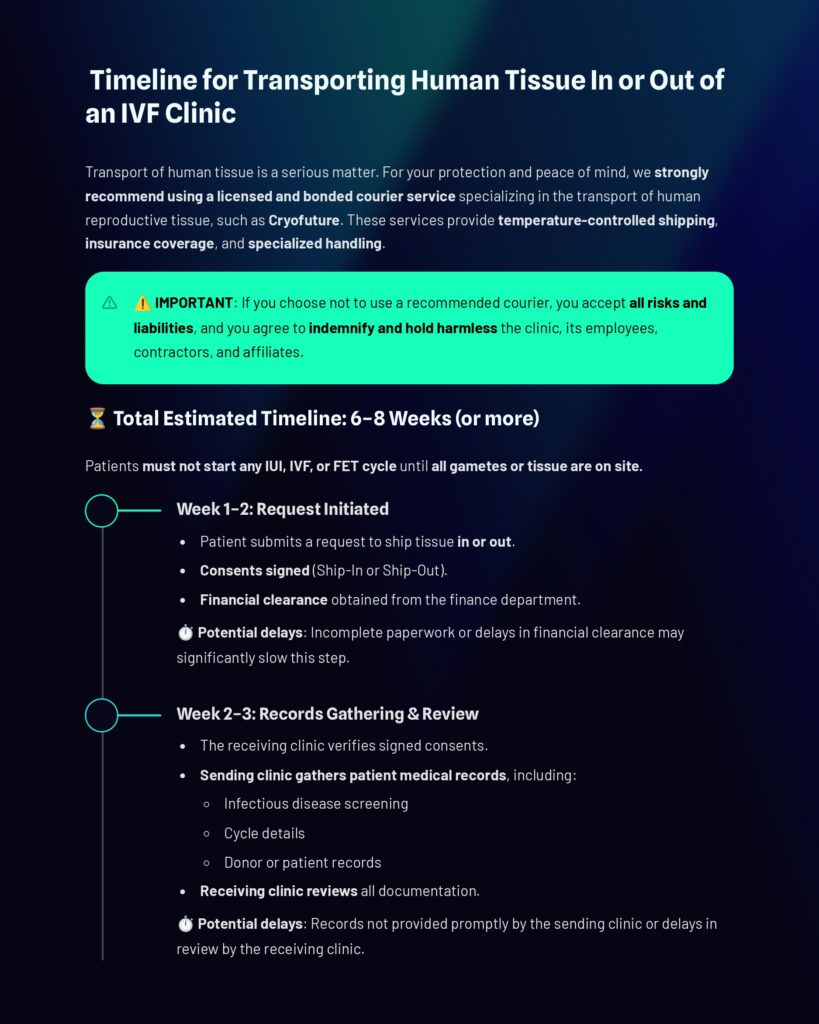
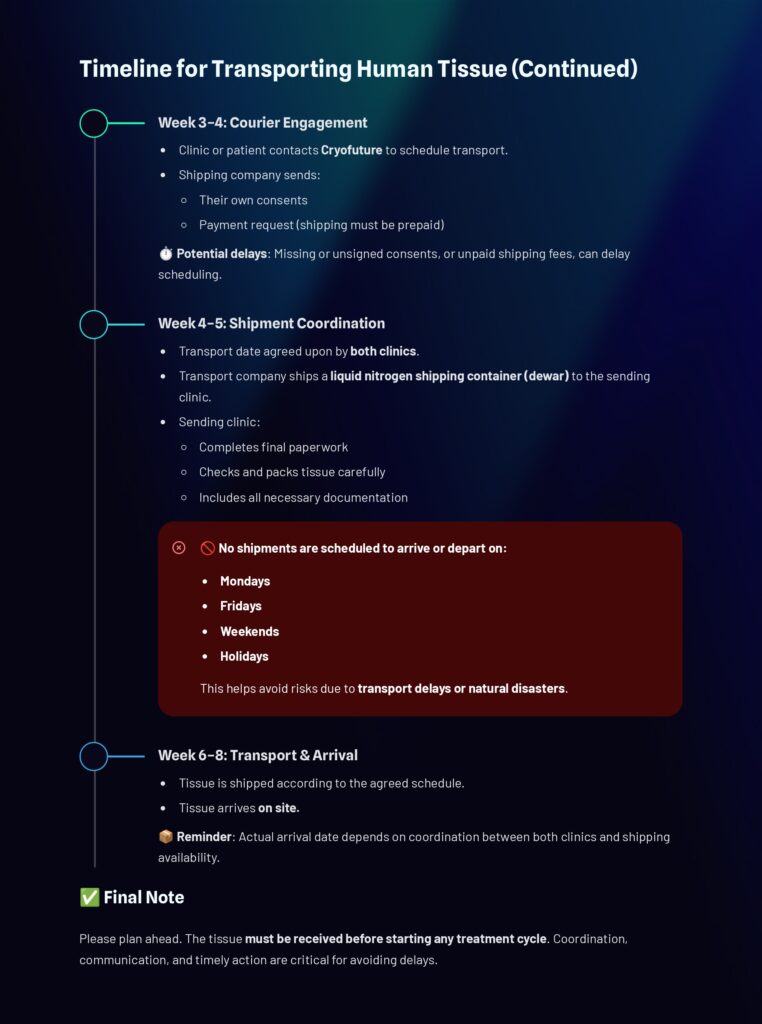
IVF Clinics take the safe transport of reproductive tissue seriously—for our patients’ protection and peace of mind.
Whether you’re coordinating a ship-in or ship-out, transporting embryos, eggs, or sperm requires 6–8 weeks and careful planning across multiple steps.
We’ve created a clear, patient-friendly infographic to guide your team and your patients through the entire process—from signing consents to confirming tissue arrival.
 Featuring recommended couriers (Cryofuture)
Step-by-step timeline
Critical reminders to avoid delays
Final note: Tissue must be on-site before any IUI, IVF, or FET cycle begins
 Download and share with your staff and patients to ensure a seamless experience.
Spring is a season of new life, renewal, and growth. It’s a time when the earth awakens from its winter sleep and bursts forth with vibrant colors and new beginnings. For those struggling with infertility, spring can symbolize hope and the possibility of new life.
If you’re waiting to get pregnant, the journey can be long and difficult. It’s easy to become overwhelmed with the daily routine of charting cycles, taking medications, and undergoing fertility treatments. But as the days get longer and warmer, it’s important to take a step back and appreciate the beauty of the season and the hope it brings.
Just as the earth goes through cycles of growth and renewal, so do our bodies. Infertility can be a frustrating and emotional rollercoaster, but it’s important to remember that every cycle is a new beginning. With each new cycle, there’s the possibility of new life, and the hope that this time will be the one.
Oocytes, or eggs, undergo a complex process of maturation before they can be fertilized. This process takes several months, and is influenced by a variety of factors, including age, genetics, and lifestyle choices. There are steps that individuals can take to support the maturation process and increase their chances of conception. One of the most effective ways is to make lifestyle changes and incorporate certain supplements into the daily routine.
For example, studies have shown that maintaining a healthy weight, exercising regularly, and reducing stress levels can all positively impact oocyte maturation and improve fertility. In addition, taking supplements such as folic acid, vitamin D, and omega-3 fatty acids can also support the maturation process and improve overall reproductive health.
Spring is also a time for self-care and renewal. Take some time to pamper yourself, whether it’s with a relaxing bubble bath, a massage, or a day out in nature. Focus on activities that bring you joy and relaxation, and don’t forget to connect with loved ones for support.
The season of renewal also provides an opportunity to reflect on your fertility journey and set new goals. Take some time to reassess your priorities, and consider any lifestyle changes that might improve your chances of conceiving. This could mean adjusting your diet, exercise routine, getting enough high quality sleep, or reducing stress levels.
Remember, you’re not alone on this journey. Seek out support from friends, family, or a professional counselor if you’re feeling overwhelmed. Spring is a season of new beginnings, and with each new cycle, there’s the possibility of new life and hope.
So, as you embrace the season of spring, remember that your journey towards parenthood is also a journey of growth and renewal. Take a deep breath, appreciate the beauty around you, and have faith that your new beginning is just around the corner